

Buy & Vet Niche Edits UK Safely 2026
Niche edits—contextual backlinks inserted into existing indexed content—remain one of the most efficient link-building tactics for UK websites in 2026, but the margin for error has narrowed significantly following Google’s February 2026 Core Update.
This guide provides a procedural framework for identifying legitimate providers, vetting placement quality, and mitigating penalty risks while operating within UK regulatory and tax compliance boundaries.
The process involves three critical phases: pre-purchase provider verification, placement quality assessment, and post-purchase monitoring. Failure to execute proper due diligence has resulted in manual actions for 28% of UK websites using low-quality link services in 2024, according to industry data.
1. Understanding Niche Edits in the 2026 UK SEO Landscape
Buying & Vetting Niche Edits UK
1.1 Definition and Operational Mechanism
Niche edits, also referred to as curated links or link insertions, involve placing a backlink within existing published content that has already achieved indexation and authority accumulation.
Key Distinction: Unlike guest posts, niche edits leverage established pages with demonstrated traffic. The provider identifies aged content, negotiates with the webmaster, and inserts a contextual link.
Google’s February 2026 Core Update intensified scrutiny on link velocity. Pages with existing authority transfer equity more efficiently than new content, which typically requires 8-12 weeks to index.
1.2 Effectiveness Under Algorithmic Pressure
Topical authority transfer is stronger when a link appears within content that genuinely addresses a related topic. However, SpamBrain AI (2025/2026 Version) now detects manipulative patterns with extreme precision.
1.3 UK Regulatory Context: VAT & GDPR
UK practitioners must follow specific rules that global guides often miss:
- VAT Compliance: Link building is a digital service. VAT-registered businesses must ensure proper invoicing.
- UK GDPR: Data Processing Agreements (DPA) are required when providers handle outreach contact info.
- Verification: Use Companies House to verify if a provider is genuinely UK-based or just a reseller for overseas PBNs.
2. Pre-Purchase Provider Verification: The Four-Stage Process
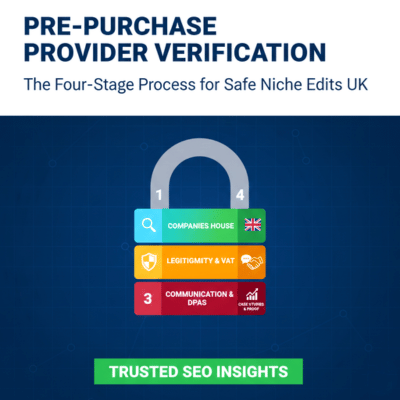
2.1 Stage One: Metric Transparency and Sample Provision
Legitimate providers demonstrate operational transparency through specific behaviors. First, they provide sample placements from previous campaigns without requiring payment. Second, they disclose their vetting methodology in detail. Third, they offer pre-approval workflows allowing client review before link activation.
The absence of these elements indicates elevated risk. Providers refusing sample disclosure typically operate PBN networks or hacked link insertion schemes—both carrying severe penalty risk. According to BuzzStream research, 34% of link builders reported negative outcomes from providers lacking transparency protocols.
A practical verification step: request three sample URLs from the provider’s recent placements. Analyze each using Ahrefs or SEMrush, examining organic traffic trends (stable or growing, not declining), referring domain quality (diverse, not spammy), and outbound link patterns (fewer than 5% OBL ratio). Declining traffic indicates potential algorithmic suppression; excessive outbound links suggest link farm participation.
2.2 Stage Two: Outreach Methodology Assessment
The method by which providers secure placements determines both quality and risk profile. White-hat niche edits result from genuine outreach to website owners, proposing editorial value additions—updated statistics, expanded context, or resource supplementation.
Grey-hat approaches involve paid insertion without editorial improvement. Black-hat methods include automated insertion via security vulnerabilities or link injection scripts.
Why does this distinction matter? Google’s December 2024 Link Spam Update specifically targeted “manipulative link-building practices,” expanding detection capabilities for automated and paid link schemes. The update documentation explicitly references “links purchased for ranking purposes without editorial value” as violation criteria.
Practitioners should verify provider methodology through direct questioning: “Describe your outreach process from initial contact to link placement.” Legitimate providers detail personalized email sequences, value propositions, and negotiation timelines. Vague responses or claims of “proprietary networks” warrant immediate disqualification.
2.3 Stage Three: Pricing Structure and Value Analysis
UK market pricing for quality niche edits ranges from £120 to £450 per placement, depending on domain rating and traffic metrics. Pricing significantly below this range (£20-£80) indicates PBN or automated placement usage. Pricing significantly above (£600+) without corresponding traffic guarantees suggests inflated margins without quality differentiation.Table
| Price Tier | Expected Quality | Risk Level | Verification Required |
|---|---|---|---|
| £120-£200 | DR 20-30, 500+ traffic | Medium | Traffic trend verification |
| £200-£350 | DR 30-50, 1K+ traffic | Low | Pre-approval workflow |
| £350-£450 | DR 50+, 5K+ traffic | Low | Content relevance check |
| Below £100 | PBN/high OBL sites | High | Avoid entirely |
The comparison demonstrates that price serves as an initial quality filter, though not a guarantee. Expensive placements from irrelevant sites deliver less value than moderately priced links from tightly contextual content.
2.4 Stage Four: Guarantee and Replacement Policies
Provider guarantees reveal confidence levels in placement stability. Industry-standard offerings include 6-12 month replacement guarantees for removed links. Lifetime guarantees, while attractive, often indicate provider desperation or unsustainable business models.
The practical implication: guarantees must specify replacement timelines and conditions. “Lifetime guarantee” without defined replacement procedures provides limited recourse. Preferred providers offer specific SLAs: replacement within 14 days for links removed within 12 months, excluding site shutdowns or editorial policy changes.
3. Placement Quality Assessment: The 10-Point Vetting Framework
3.1 Technical Metrics Verification
Effective vetting requires systematic evaluation across ten dimensions. Domain Rating (DR) and Domain Authority (DA) provide initial filtering but prove insufficient alone. Traffic verification using Ahrefs or SimilarWeb confirms genuine audience engagement—fake DR inflation through manipulated backlinks creates hollow metrics without traffic correlation.
Critical verification points include: organic traffic trend stability (6-month minimum), traffic geographic distribution (UK audience percentage for UK-targeted campaigns), referring domain diversity (avoidance of link farm patterns), and index status (Google-indexed pages only). Each metric serves a specific protective function. Traffic trends reveal algorithmic suppression; geographic distribution ensures audience relevance; referring domain diversity indicates natural link acquisition; index status confirms crawlability.
3.2 Content and Contextual Relevance Analysis
The surrounding content determines link value more than domain metrics alone. Evaluation criteria include: topical alignment between host content and target site, content quality indicators (grammar, depth, originality), update frequency (actively maintained sites vs. abandoned properties), and editorial standards (clear authorship, contact information, about pages).
What happens when relevance is ignored? Google’s semantic understanding, enhanced through the 2024 Helpful Content Updates, devalues links from topically disconnected content. A financial services link within a cooking blog, regardless of domain authority, transfers minimal ranking benefit and may trigger relevance-based filtering.
3.3 Risk Pattern Detection
Specific patterns indicate elevated penalty risk. These include: excessive JavaScript rendering (inhibiting crawler access), recent domain ownership changes (potential expired domain abuse), thin content indicators (low word count, high ad density), and outbound link profile analysis (excessive external links, irrelevant linking patterns).
The February 2026 Core Update specifically addressed “excessive JavaScript” as a negative factor, with Google confirming that 28% of Googlebot traffic now consists of AI crawlers with limited JavaScript execution capabilities. Links placed on JS-heavy pages may not be discovered or valued.
4. Post-Purchase Monitoring and Risk Mitigation
4.1 Link Monitoring Protocols
Active monitoring prevents silent devaluation. Recommended practices include: monthly verification of link status (live vs. removed), traffic monitoring of host pages (declining traffic indicates site quality issues), anchor text distribution analysis (avoiding over-optimization patterns), and ranking correlation tracking (attributing improvements to specific placements).
Documentation serves protective functions. Maintain records of all placement URLs, acquisition dates, provider communications, and vetting documentation. In the event of manual action, this documentation supports reconsideration requests by demonstrating due diligence intent.
4.2 Penalty Response Procedures
Despite proper vetting, algorithmic changes may affect previously safe placements. Response protocols include: immediate link removal request to provider (utilizing replacement guarantees), disavow file preparation for toxic placements (using Google Search Console), and reconsideration request documentation (if manual action issued).
The distinction between algorithmic devaluation and manual action matters procedurally. Algorithmic impacts require quality improvement and natural link acquisition balance. Manual actions require specific remediation and formal reconsideration.
5. Common Mistakes and Consequence Analysis
5.1 Volume-Over-Quality Approach
Practitioners frequently prioritize link quantity over placement quality, acquiring 20-50 low-cost links rather than 5-10 verified quality placements. This approach triggers velocity-based algorithmic flags. Google’s systems expect organic growth patterns; rapid acquisition of multiple paid links without corresponding organic signals creates detectable manipulation patterns.
The consequence extends beyond devaluation. Sites exhibiting consistent pattern manipulation may enter heightened monitoring status, where subsequent link acquisitions face increased scrutiny regardless of quality.
5.2 Anchor Text Over-Optimization
Exact-match anchor text distribution exceeding 20% of total backlink profile triggers over-optimization filters. Natural link profiles exhibit branded, generic, and partial-match variations. Niche edit providers offering “optimized anchor text” without distribution analysis create penalty exposure.
Case example: A Manchester-based e-commerce site acquired 15 niche edits with exact-match “buy [product] UK” anchors within 30 days. Google’s April 2024 algorithm update detected the pattern, resulting in 40% ranking loss for target terms. Recovery required 6 months of natural link acquisition and anchor text diversification.
6. Frequently Asked Questions
Q1: Are niche edits legal under UK law?
A: Niche edits themselves are not illegal. However, undisclosed paid links violate Google’s Webmaster Guidelines. UK businesses must ensure VAT compliance for link building services and GDPR compliance for data processing.
Q2: How long do niche edit results take to appear?
A: Indexation and ranking impact typically manifest within 4-8 weeks. Pages with higher existing authority transfer equity faster than lower-authority placements.
Q3: Can niche edits cause Google penalties?
A: Low-quality placements from PBNs, irrelevant sites, or automated insertion can trigger manual actions. Quality placements from vetted sites carry minimal penalty risk but may be devalued if algorithmic patterns detect manipulation.
Q4: What is the difference between niche edits and guest posts?
A: Niche edits insert links into existing indexed content. Guest posts require new content creation. Niche edits offer faster impact; guest posts offer greater content control and brand visibility.
Q5: How many niche edits per month are safe?
A: Safe velocity depends on existing authority and organic growth patterns. New sites should limit to 2-3 monthly placements. Established sites with strong organic signals can accommodate 5-8 monthly acquisitions without pattern detection.
Q6: Should I buy niche edits for a new website?
A: New websites lack the authority foundation to benefit significantly from niche edits. Priority should be content development, technical SEO, and initial natural link acquisition. Niche edits become appropriate after 6-12 months of establishment.
Q7: How do I verify a UK provider’s legitimacy?
A: Check Companies House registration (free online search), request UK business address verification, and confirm VAT registration for invoice purposes. Providers unable to supply this information likely operate as international resellers.
Q8: What documentation should I maintain for compliance?
A: Maintain records of provider vetting, placement URLs, acquisition dates, replacement guarantee terms, and traffic verification screenshots. This documentation supports reconsideration requests if manual actions occur.
Q9: Can I remove niche edits if they cause problems?
A: Link removal depends on provider cooperation and webmaster responsiveness. Replacement guarantees typically cover removal within specified periods. For toxic placements, Google Search Console disavow tool provides last-resort protection.
Q10: Are niche edits better than digital PR for UK sites?
A: Digital PR typically delivers higher authority links with brand visibility benefits but requires significantly higher investment (£2,000-£10,000 per campaign vs. £200-£400 per niche edit). Niche edits offer cost-efficient authority building; digital PR offers comprehensive brand authority development.
Author Expertise
This guide was developed through systematic analysis of Google’s algorithm updates (2023-2026), industry research from Ahrefs, Moz, and Search Engine Journal, and procedural review of UK VAT and data protection requirements. The framework reflects current search engine compliance standards and regulatory obligations for UK-based digital marketing operations.


Pingback: Buy Guest Post UK 2026: Compliance & Risk Assessment Guide
Pingback: Buy Europe Guest Posts | 15+ Verified DA 30+ Sites (2026)