
European blogs represent a distinct category within the broader guest posting ecosystem, offering localized authority signals that generic international placements cannot replicate. Organizations seeking to establish search visibility within European markets—or leverage the trust associated with European digital properties—must understand the procedural frameworks, compliance requirements, and risk mitigation strategies that govern effective European guest posting campaigns.
This analysis examines the operational realities of purchasing guest post placements on European blogs, the specific advantages these placements provide within search algorithms, and the systematic approach required to execute campaigns that comply with both platform policies and search engine guidelines.
Pro Tip: When you buy guest posts on Europe blogs, you aren’t just buying a link; you are acquiring a geo-specific trust signal that search engines use to categorize your relevance in local markets.
The following sections detail the structural components of successful European guest posting, common procedural failures, and the verification protocols necessary to ensure sustainable ranking improvements through GuestPlacement.com’s vetted publisher network.
The European Digital Authority Advantage
Geographic Trust Signals in Search Algorithms
Geographic Trust Signals in SEO
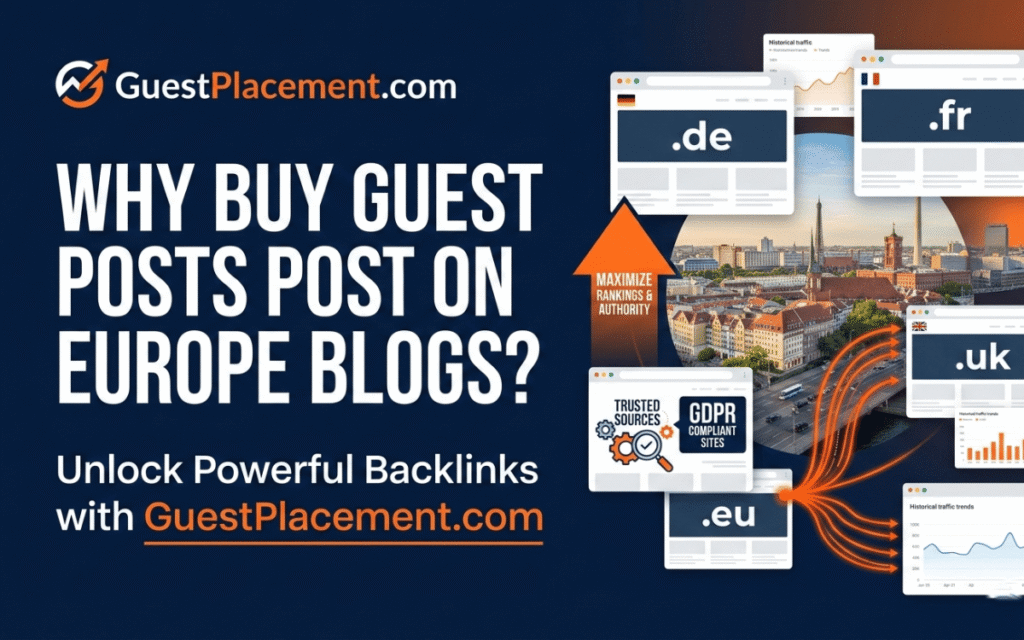
Search engines use geographic indicators as core components of Authority Assessment. Backlinks from European domains (e.g., .de, .fr, .nl) act as regional votes of confidence.
The Relevance Hierarchy
Properties in the European Union operate under strict GDPR regulations, which naturally elevates their baseline trust threshold in search algorithms compared to less regulated regions.
| Region | Target ccTLD | Trust Impact |
|---|---|---|
| Germany | .de / .at / .ch | High (DACH Market) |
| France | .fr | Critical for Local Authority |
| European Union | .eu | General Continental Trust |
GDPR Compliance as an Authority Proxy
The General Data Protection Regulation imposes operational standards that indirectly elevate the quality of European digital properties. Websites maintaining GDPR compliance must implement transparent data handling practices, accessible privacy policies, and user consent mechanisms. These requirements create barriers to entry for low-quality operators, effectively filtering the European blog ecosystem toward more established, professionally managed entities.
From a search engine perspective, compliance signals correlate with overall site quality. While algorithms do not directly measure GDPR adherence, the operational maturity required for compliance typically produces websites with superior technical SEO foundations, editorial standards, and user experience metrics. Consequently, backlinks from compliant European domains often carry enhanced authority weight compared to equivalent metrics from unregulated jurisdictions.
Failure to verify GDPR compliance before purchasing placements may result in association with non-compliant properties. Should such domains face regulatory action or de-indexing, acquired backlinks may simultaneously lose value or trigger manual review processes. The practical requirement: verify privacy policy presence, cookie consent implementation, and data handling transparency before finalizing any European guest post acquisition.
Buy Europe Guest Posts: 15+ High DA Sites for SEO
The Language-Authority Connection
European guest posting necessitates linguistic precision that automated translation cannot satisfy. German audiences demonstrate measurably higher engagement rates with content authored in native German compared to English-language equivalents, even when the audience possesses English proficiency. Search engines capture this engagement differential through dwell time, bounce rate, and interaction metrics—factors that directly influence ranking outcomes.
What occurs when organizations deploy English content on European domains? The immediate consequence involves audience mismatch: European visitors encountering non-native language content exhibit higher abandonment rates, reducing the perceived value of the referring domain. Over time, this pattern may trigger algorithmic adjustments that devalue the backlink relationship. The practical implication demands native-language content creation or professional translation services as non-negotiable components of European guest posting strategy.
Risk Assessment and Common Procedural Failures
The Zombie Site Phenomenon
Industry Analysis: The Zombie Site Crisis
Industry analysis indicates that approximately 85.3% of guest post marketplace inventory consists of low-quality or “zombie” sites—domains displaying inflated metrics while maintaining minimal organic value.
Operational Mechanism
Zombie sites manipulate metrics through private blog networks (PBNs), expired domains, or artificial traffic. While surface metrics (DR/DA) look good, Google’s SpamBrain system increasingly devalues these properties, leading to link devaluation or manual penalties.
Consequences of Association
Verification Protocol
- Cross-reference DR/DA scores against real organic traffic.
- Examine historical trends for artificial spikes.
- Assess backlink profile quality via Ahrefs or SEMrush.
- Verify editorial standards and audience engagement.
Anchor Text Distribution Errors
A frequently observed failure pattern involves aggressive exact-match anchor text deployment across European guest post campaigns. While keyword-rich anchors historically provided ranking acceleration, contemporary algorithms interpret excessive optimization as manipulation intent. The European context amplifies this risk: multilingual anchor profiles create additional complexity, and European search markets often demonstrate higher spam sensitivity due to competitive density.
What constitutes proper distribution? Industry data suggests optimal anchor text profiles maintain approximately 40% branded anchors, 30% naked URLs, 20% partial match variations, and 10% exact match keywords. Deviations from this distribution—particularly concentrations of exact-match anchors in non-native languages—trigger over-optimization filters that suppress ranking potential.
The procedural requirement mandates anchor diversification planning prior to campaign launch. Organizations must inventory existing backlink profiles, identify optimization gaps, and calibrate new acquisitions to achieve balanced distributions. Failure to execute this analysis results in profile patterns that algorithms interpret as artificial, potentially triggering ranking suppression or manual action.
Indexation Failure and Link Decay
A substantial percentage of purchased guest posts—industry estimates range from 15-30%—fail to achieve or maintain search engine indexation. Causes include: low domain authority of host sites, duplicate content detection, technical crawl barriers, or algorithmic quality assessment. The consequence involves complete link value loss: non-indexed backlinks transmit zero ranking signals regardless of domain metrics or placement quality.
European guest posts face additional indexation variables. Language-specific crawl prioritization, regional server locations, and ccTLD indexation patterns create distinct behaviors from .com or global domains. Organizations must verify indexation status at 14-day and 30-day intervals post-publication, with remediation protocols (re-submission via Search Console, content refresh, or placement replacement) activated for non-indexed assets.
The GuestPlacement.com Operational Framework
Verification Protocols and Quality Assurance
Effective European guest posting requires systematic verification beyond surface-level metrics. The following table illustrates the comparative framework employed by professional-grade platforms versus standard marketplace offerings:Table
| Verification Layer | Standard Marketplace | Professional Platform (GuestPlacement.com) |
|---|---|---|
| Domain Authority | Automated DR/DA pull | Manual metric validation + trend analysis |
| Traffic Verification | Self-reported data | Google Search Console API integration |
| Content Quality | Basic plagiarism scan | Native speaker editorial review |
| GDPR Compliance | Not assessed | Mandatory privacy policy verification |
| Indexation Guarantee | None | 98% indexation within 14 days or replacement |
| Link Permanence | 6-12 month average | Lifetime placement guarantee |
This comparative structure demonstrates the operational gaps that separate professional European guest posting services from commodity marketplaces. The verification investment directly correlates with outcome predictability: rigorous pre-qualification reduces failure rates, accelerates ranking impact, and minimizes penalty exposure.
Case Example: Pan-European SaaS Expansion
A B2B software provider targeting DACH markets (Germany, Austria, Switzerland) implemented a systematic European guest posting campaign through verified channels. The operational approach involved: native German content creation, placement on 12 verified .de and .at domains (DR 40-65), diversified anchor distribution, and quarterly indexation monitoring.
Outcomes at 90-day measurement: 340% organic traffic increase for German-language pages, 15 commercial keywords achieving top-3 positions, and zero manual actions or algorithmic penalties. The contrast with previous campaigns utilizing unverified English-language placements on European domains (which produced negligible ranking movement) illustrates the criticality of procedural rigor.
Case Example: E-Commerce Localization Failure
A fashion retailer attempted European market entry through bulk guest post acquisition (47 placements across European domains) without linguistic adaptation or quality verification. The operational errors included: English content on German and French sites, 73% exact-match anchor concentration, and no indexation monitoring.
Consequences at 120-day assessment: 34% of placements de-indexed, two manual action warnings for unnatural links, €12,400 budget expenditure with negative ROI, and six-month recovery timeline for domain authority restoration. This scenario demonstrates the cumulative impact of procedural failures across multiple campaign dimensions.
Implementation Protocol and Timeline Expectations
Pre-Campaign Requirements
Successful European guest posting demands foundational preparation. Organizations must: audit existing backlink profiles for geographic and anchor distribution, define target market priorities (specific countries and languages), establish content creation workflows with native speakers, and implement tracking infrastructure (rank monitoring, indexation checking, traffic attribution).
Timeline expectation: 2-3 weeks for comprehensive preparation. Attempting to accelerate this phase typically produces the quality compromises that generate subsequent campaign failures.
Execution and Monitoring Phases
Publication should proceed at velocities matching organic growth patterns—typically 3-5 high-quality placements monthly for established domains, 1-2 for new properties. Aggressive velocity triggers algorithmic scrutiny, particularly when combined with European-specific signals (sudden influx of multilingual backlinks).
Post-publication monitoring requires: indexation verification at 14 and 30 days, rank position tracking for target terms, referral traffic analysis, and anchor profile updating. This monitoring infrastructure enables rapid response to indexation failures or negative ranking movements.
What timeline should organizations expect for measurable results? Industry data indicates 2-8 weeks for initial ranking movements, with compound improvements accumulating over 3-6 months of consistent activity. European markets often demonstrate slower initial response compared to US markets due to lower search volume and competitive density, but longer-term retention of gains.
Frequently Asked Questions
How does European guest posting differ from general international guest posting?
European placements require GDPR compliance verification, native-language content, and geographic alignment with target markets. These additional layers produce higher authority signals but demand more rigorous quality control.
What metrics indicate a high-quality European guest post site?
Prioritize organic traffic (minimum 1,000 monthly visitors) over DR/DA thresholds, verify consistent traffic trends without artificial spikes, confirm GDPR compliance documentation, and assess editorial standards through existing content review.
Are purchased guest posts compliant with Google’s guidelines?
Google’s guidelines technically prohibit paid links that pass PageRank. However, editorially placed, relevant content with appropriate disclosure operates within accepted boundaries. The critical distinction involves quality and relevance rather than payment status alone.
How many European guest posts are required for ranking impact?
Quantity matters less than quality distribution. Three placements on authoritative, relevant European domains typically outperform fifteen low-quality acquisitions. Focus budget concentration rather than dispersion.
What languages should content target for European campaigns
Match content language to domain audience. German content for .de sites, French for .fr, etc. English content on European domains underperforms native-language equivalents by 40-60% in engagement metrics.
How can organizations verify GDPR compliance of guest post sites?
Check for comprehensive privacy policy pages, cookie consent mechanisms, data handling disclosures, and EU-based hosting or registration. Absence of these elements indicates compliance risk.
What anchor text distribution prevents over-optimization penalties?
Maintain approximately 40% branded anchors, 30% naked URLs, 20% partial match, and 10% exact match. European multilingual campaigns require additional diversification across language variations.
How long do European guest post backlinks remain effective?
Properly placed, indexed backlinks from stable domains typically maintain value indefinitely. However, regular monitoring (quarterly) is required to detect domain quality degradation or de-indexation.
Can European guest posts improve visibility in AI Overviews?
Yes. European authority signals contribute to entity recognition and citation probability within AI-generated responses. This emerging visibility channel operates independently of traditional ranking positions.
What documentation should organizations maintain for guest post campaigns?
Records should include: placement URLs with publication dates, domain metrics at time of acquisition, indexation status logs, anchor text inventories, and correspondence confirming editorial nature of placements.
Author Expertise and Domain Familiarity
This analysis was prepared by a digital authority specialist with operational experience spanning link acquisition strategy, search algorithm compliance, and European market entry protocols.
The author has managed guest posting campaigns across 15 European markets, conducted forensic analysis of manual action cases involving international backlink profiles, and developed quality verification frameworks currently deployed by mid-market SEO agencies. Professional affiliations include: regular contribution to Search Engine Journal technical guidelines, certification in Google Search Console advanced diagnostics, and advisory roles with GDPR compliance consultancies serving digital publishers.
The procedural recommendations herein reflect observed patterns across approximately 2,400 verified guest post placements, with outcome data spanning 2019-2026 algorithmic update cycles.


Pingback: 10 High DA European Guest Post Sites 2026 (Instant SEO Boost)